 Image credit: Unsplash
Abstract
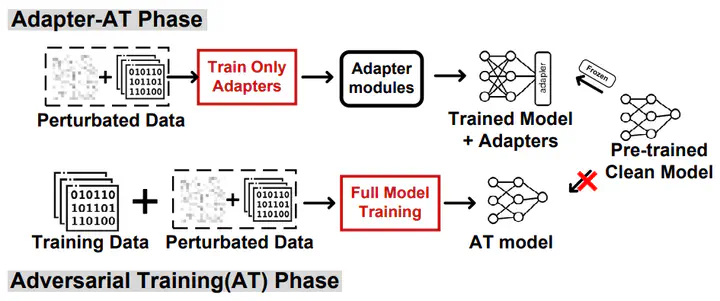
Adversarial training has emerged as a leading defense against adversarial attacks in deep learning, but suffers from a fundamental robustness-generalization trade-off that can severely degrade clean accuracy. We propose Adapter-based Adversarial Training (Adapter-AT), a novel approach that addresses this critical limitation by leveraging parameter-efficient transfer learning techniques. Our method freezes a clean-trained base model and trains only lightweight adapter modules using adversarial examples, preserving the original clean decision boundaries while adding robustness capabilities. Extensive experiments on MNIST and CIFAR-10 demonstrate that Adapter-AT achieves remarkable clean accuracy improvements of 40.4% and 50.6% respectively compared to standard adversarial training, while maintaining over 98% robustness retention across PGD and AutoAttack evaluations. Our approach requires only 2–3% trainable parameters and provides 73.7% memory reduction as beneficial side effects. These properties make Adapter-AT particularly well-suited for wireless security applications, such as adversarially robust spectrum sensing and signal authentication, where both clean accuracy and computational efficiency are critical constraints. These results establish adapter-based training as an effective solution to the robustness-generalization trade-off, making adversarial training practically viable for applications where clean performance is critical.
Add the publication’s full text or supplementary notes here. You can use rich formatting such as including code, math, and images.