VOID: Backdoor Injection through Knowledge Vacuity in Federated Unlearning
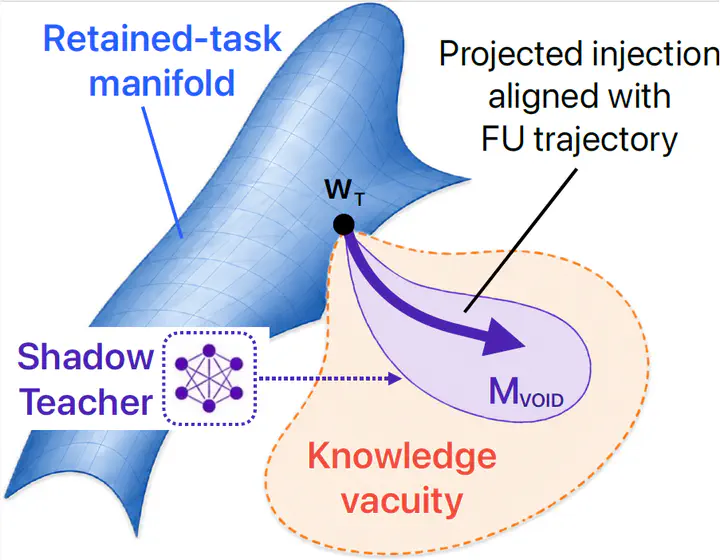 Image credit: Unsplash
Abstract
Federated unlearning (FU) enables federated systems to remove designated data from a trained global model, but its security risks remain poorly understood. We show that calibration-based FU introduces a structural vulnerability through finite-step post-hoc corrections, which leave behind \emph{knowledge vacuity} in weakly constrained residual dimensions where the unlearned data’s influence is suppressed while retained-task recovery pressure remains limited. We propose VOID, an unlearning-phase backdoor attack that exploits knowledge vacuity to implant trigger semantics along the legitimate unlearning trajectory. VOID identifies these residual dimensions through influence-based trajectory estimation and neuron-level vacuity profiling, then performs masked semantic substitution during unlearning. Across datasets and FU methods, VOID achieves up to 99% attack success, preserves clean accuracy, and persists after post-unlearning finetuning. Our results show that approximate forgetting can expose writable capacity for adversarial reuse.
Add the publication’s full text or supplementary notes here. You can use rich formatting such as including code, math, and images.